Your browser is out of date.

You are currently using Internet Explorer 7/8/9, which is not supported by our site. For the best experience, please use one of the latest browsers.

Urethane Die Tooling

Metal fabrication operations face ongoing pressure to improve efficiency while maintaining surface quality on finished parts. Industries from automotive to aerospace require bending and forming solutions that protect pre-finished materials while delivering dimensional consistency. Traditional steel dies create witness marks on polished stainless steel, brushed aluminum, and painted surfaces - defects that require costly secondary finishing operations.

Polyurethane Products Corp. manufactures high-performance thermoset elastomers and engineered solutions for the metal fabrication industry. For over 45 years, our facility has produced specialized components that solve complex forming challenges while protecting sensitive material surfaces.

This guide examines how urethane die tooling functions in metal fabrication environments, the performance advantages over conventional steel dies, and the specific product categories we offer for radius forming, press brake operations, and stamping applications.

Polyurethane Forming Dies
and Die Tooling Solutions

Die-Thane represents Polyurethane Products Corp.'s trade name for tooling-grade urethane formulated to withstand metal forming demands. The company manufactures three primary categories: radius tooling featuring the patented SMART PAD® System for universal radius bending without bottom die changes, press brake solutions including V-dies, V-pads, and die film compatible with Amada, Trumpf, and American systems, and urethane springs that outperform steel where corrosion, vibration, or magnetism create operational challenges.

What is Press Brake Tooling?

Why Use Urethane Die Tooling

Steel dies excel in high-volume production, requiring maximum rigidity, but create problems when surface quality determines part acceptability. Every contact point between steel tooling and polished metal risks scratching or marking.

Urethane eliminates witness marks through its fundamental material properties. The durometer rating - measured on Shore A or Shore D scales - determines hardness level. Softer grades conform to workpiece contours while harder grades substitute for steel dies in applications where full steel strength isn't necessary. The material changes shape during forming, reducing springback by approximately 60% compared to conventional tooling. Metal stretches more evenly across the bend radius, which reduces split risk while improving dimensional consistency.

Key Operational Benefits of Die-Thane Tooling

Implementing Die-Thane tooling directly addresses the cost and quality bottlenecks associated with traditional metal forming. By switching from rigid steel to a dynamic elastomer, fabrication shops achieve immediate improvements in throughput and part quality:

Surface protection
Surface protection

The elastomer material prevents marring and scratches on pre-painted, polished, or stainless steel surfaces, eliminating secondary finishing steps.

Springback control
Springback control

Tooling configurations reduce material springback by up to 60% compared to conventional steel dies, improving dimensional consistency.

Cost efficiency
Cost efficiency

A single, versatile urethane block often replaces multiple custom steel die openings, lowering overall tooling investments.

Repeatability
Repeatability

High-performance elastomer compounds maintain strict dimensional stability over extended production runs.

Urethane Tooling for Press Brake and Forming Operations

Soft Urethane Pads

Soft urethane pads create a forming method distinct from air bending or bottom bending. Under load, the material flows into cavities while forcing the workpiece to conform to the punch shape. This produces results similar to bottom-bent or coined parts with minimal tool wear, particularly effective for delicate or coated materials where surface integrity cannot be compromised.

Hard Urethane Dies & Die Film

Hard urethane dies resist deformation while maintaining controlled flexibility. These substitute for traditional metal dies in specific bending applications by holding a defined shape under pressure. The film creates a non-marring barrier between die and workpiece during precision bending operations, preventing scratches on cosmetic parts while extending die life by reducing wear on underlying steel tooling.

Urethane Tooling Product Categories

Polyurethane Products Corp. organizes its urethane die tooling into distinct categories designed to address specific metal fabrication challenges. Each product line solves particular forming requirements while maintaining the surface protection and performance advantages inherent to urethane tooling.

Polyurethane Products Corp. manufactures specialized  radius-tooling radius inserts  engineered to create consistent, large-radius bends without the 'multi-break' defects common to steel tooling. These inserts deliver smooth, continuous radial profiles on cosmetic parts.

Our radius tooling line includes two standardized geometries:

  • PODs (Poly Die). Feature flat forming surfaces designed for precise 90-degree V-bends.
  • PUDs (Poly-U Die). Built with molded U-shapes to execute 180-degree U-bends in a single press stroke.

Both feature molded holes to reduce tonnage requirements, stress relief design for extended service life, and compatibility with standard steel channel holders. Lengths extend up to 48 inches with mountable American, European, and Trumpf tangs.

Molded-tang polyurethane forming pads feature an integrated tang design for direct press-brake mounting without separate holders, while metric pads match international equipment standards for global manufacturing operations.

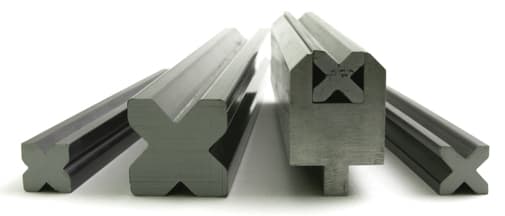
Press brake tooling includes Die-Thane pads, holders, and universal die blocks that fit into standard press brake rails. These components integrate directly with existing equipment to upgrade surface protection for any job without requiring press brake modifications.

Press Brake Tooling

Urethane springs outperform traditional steel springs in harsh industrial environments. They resist shattering and withstand significant overloads without permanent deformation, which makes them particularly suitable for stamping applications where steel spring failure creates operational hazards.

We also develop custom radius tooling for specialized applications beyond standard offerings, working directly with fabricators to address unique forming requirements.

Press Brake Tooling

FAQs

Polyurethane Products Corp. organizes its urethane die tooling into distinct categories designed to address specific metal fabrication challenges. Each product line solves particular forming requirements while maintaining the surface protection and performance advantages inherent to urethane tooling.

Urethane functions as a solid hydraulic material under compression, dispersing pressure evenly in all directions without volume change. Steel dies maintain fixed geometry throughout the forming process. This fundamental difference enables urethane to prevent surface damage, reduce springback, and accomplish complex forming operations that would require expensive machined steel tooling.

Service life depends on material gauge, production volume, and forming severity. Urethane won't outlast steel in continuous high-volume production exceeding hundreds of thousands of parts annually. For runs under 50,000 parts or low-to-medium volume operations, urethane delivers acceptable longevity at significantly lower initial investment.

When forming heavier gauges, material thickness dictates tool behavior. For workpieces exceeding 0.500”, selecting a lower durometer elastomer provides the necessary compliance. Fabricators must engineer precise cutting clearances to minimize stripping forces and prevent tool damage. Press brake tonnage requirements increase with urethane compared to steel V-dies because the equipment must overcome resistance from both sheet metal and urethane pad compression.

Metal fabrication operations serving multiple sectors utilize this tooling. Automotive manufacturers require mar-free forming on body panels. Aerospace fabricators work with aluminum and specialty alloys. Appliance manufacturers protect painted and pre-finished surfaces. Food and beverage equipment producers require polished stainless steel. Agricultural machinery builders form galvanized and painted components. Robotics and EV manufacturers work with aluminum structural parts. Safety equipment producers require precise bends without surface defects.

Our tooling integrates with standard American, European, Amada, and Trumpf press brake systems. Tangs and mounting configurations match industry standards. Poly die pads fit in standard steel channel holders that mount to existing equipment without modification. We provide application assistance to ensure proper tooling selection for your specific press brake model.

Application requirements determine optimal durometer selection. Softer grades in the Shore A range suit gentle forming operations and thick materials. Harder grades in the Shore D range substitute for steel dies and provide rigid punch stripper encapsulation. Our technical team assists with durometer specification based on your material type, thickness, bend radius, and forming requirements.

Contact Polyurethane Products Corp. to Learn More

Polyurethane Products Corp. has manufactured high-performance urethane die tooling for metal fabrication operations since 1978. The company's ISO 9001:2015 certification demonstrates a commitment to quality systems and continuous improvement.

Whether you need radius tooling for large radius bends, press brake solutions for mar-free forming, or urethane springs for stamping operations, the technical team helps identify the right products for your specific challenges. Request a quote to discuss your metal forming needs, or contact the team for technical assistance with tool selection and implementation.

Request a quote Contact the team
Quick Contact
Have a Question?

You have questions, we have answers. Contact us today. Our skilled customer service specialists can help you make the right choice in polyurethane applications.