
How To Choose the Right Press Brake Tooling for Your Application

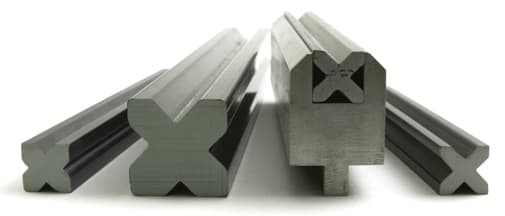
Custom press brake tooling directly impacts bend accuracy, surface quality, and long-term production efficiency. Choosing the wrong tooling leads to inconsistent bends, excessive wear, and unnecessary downtime. If you want predictable performance, you need a structured approach to selecting tooling that matches your press, material, and output requirements.
This guide breaks down how to select press brake tooling step by step.
Step 1: Confirm Your Press Capacity and Tonnage
Start with your machine. Every tooling decision must align with available tonnage, bed length, and clamping style.
- Verify maximum tonnage per foot
- Confirm whether you operate a mechanical, hydraulic, or servo press brake
- Identify your clamping system (American, European, Wila-style, etc.)
Tooling must handle the force required without deflection. Exceeding rated capacity shortens tool life and compromises accuracy.

Step 2: Define Material Type and Thickness
Material characteristics influence die opening, punch radius, and required forming pressure.
Consider:
- Material grade (mild steel, stainless, aluminum)
- Thickness range
- Surface sensitivity
- Yield strength and springback tendencies
Thicker or high-strength materials require more robust tooling. Thin or polished metals often benefit from urethane-assisted press brake tooling solutions that reduce marking and distribute load more evenly.
Step 3: Determine Bend Requirements
Next, identify what you are actually forming.
- Required bend angle
- Inside bend radius
- Flange length
- Tolerance requirements
For tight radii and high repeatability, hardened steel punches and dies are often necessary. For specialty forming or surface protection, custom brake press tooling may incorporate urethane pads or Die-Thane® components from Polyurethane Products to control pressure and reduce part damage.
Step 4: Evaluate Production Volume
Production scale affects tooling investment decisions.
High-volume operations benefit from hardened, precision-ground tooling built for long wear cycles. Short-run or prototype work may justify more adaptable tooling systems that allow faster changeovers.
Custom press brake tooling becomes especially valuable when a recurring job requires consistent performance across thousands of cycles.
Step 5: Compare Standard vs Custom Tooling
Standard tooling works for common bends and widely used material thicknesses. Custom tooling addresses unique geometries, deep draws, oversized radii, or specialized forming challenges.
Polyurethane Products provides engineered press brake tooling solutions that integrate urethane components to extend tool life, improve bend consistency, and protect finished surfaces. Custom-cast urethane elements can complement steel tooling for enhanced flexibility without sacrificing control.
Step 6: Factor in Long-Term Maintenance and Wear
Tool selection is not only about initial performance. Consider:
- Wear resistance
- Ease of replacement
- Compatibility with existing tooling
- Maintenance frequency
Well-designed custom brake press tooling reduces downtime and supports predictable maintenance schedules.
Press Brake Tooling Solutions Built for Performance
Choosing the right tooling requires more than matching dimensions. It requires understanding how force, material behavior, and tool design interact under real production conditions.
Polyurethane Products manufactures custom press brake tooling and engineered urethane components designed to enhance steel tooling systems. Whether you need improved surface protection, controlled force distribution, or application-specific forming support, their team can develop press brake tooling solutions tailored to your operation.
Contact Polyurethane Products to discuss custom press brake tooling built for precision, durability, and consistent performance.
FAQs
Custom press brake tooling is application-specific tooling designed to match unique bend geometries, material types, and production requirements. Unlike standard tooling, it is engineered to address specific tolerances, surface protection needs, or complex forming challenges.
Required tonnage depends on material type, thickness, bend length, and die opening. Manufacturers calculate tonnage per foot based on material yield strength and multiply it by the total bend length. Tooling must be rated to safely handle that force without deflection.
When selecting press brake tooling, evaluate material thickness, hardness, and finish sensitivity. Hardened steel tooling works well for heavy-gauge or high-strength metals, while urethane-assisted press brake tooling solutions can help protect delicate finishes and distribute pressure more evenly.
Custom press brake tooling is recommended when forming complex geometries, maintaining tight tolerances, running high production volumes, or addressing recurring quality issues. It is also beneficial when surface marking, springback, or tool wear becomes a consistent problem.
Yes. Urethane pads and forming components can complement steel tooling by improving force distribution, reducing vibration, and protecting finished surfaces. These integrated press brake tooling solutions are often used for specialty forming applications.
Have a Question?
You have questions, we have answers. Contact us today. Our skilled customer service specialists can help you make the right choice in polyurethane applications.